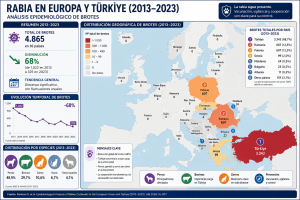
A study analyzed the evolution of rabies in the European Union and Turkey between 2013 and 2023, showing an overall reduction in outbreaks of 68% (from 1,022 to 325). A total of 4,865 outbreaks were reported in 16 countries. Turkey accounted for 68% of the outbreaks, followed by Romania and Poland. Transmission is linked to domestic dogs, cattle, and foxes. The COVID-19 pandemic may have caused a temporary increase in cases due to the disruption of vaccination and surveillance programs. The study emphasizes the need to maintain animal vaccination, strengthen cross-border cooperation, and improve surveillance under a One Health approach.
Rabies in Europe and Turkey: Fewer Outbreaks, but the Threat Persists.
A new study published in the journal Life analyzes the epidemiological evolution of rabies in the European Union and Turkey between 2013 and 2023, showing a significant overall reduction in outbreaks, although with persistent hotspots in Eastern Europe and border regions. During the study period, 4,865 outbreaks were reported in 16 countries, representing an approximate 68% decrease, from 1,022 outbreaks in 2013 to 325 in 2023. However, the authors caution that the trend has not been linear and that active endemic areas persist. Turkey bears the greatest epidemiological burden, accounting for more than 68% of all outbreaks recorded during the analyzed decade, followed by Romania and Poland. The study identifies a clear geographical concentration in Eastern and Southeastern Europe. The epidemiological maps included in the study show how, although many European countries have drastically reduced cases thanks to oral vaccination campaigns in wildlife and systematic vaccination of domestic animals, regional hotspots persist where the virus continues to circulate. Dogs, livestock, and wildlife: key to transmission.
The study highlights that: Domestic dogs continue to be one of the main epidemiological reservoirs. Cattle accounted for a large proportion of cases in Turkey. Foxes continue to play a crucial role as a wildlife reservoir and epidemiological bridge. The authors further emphasize the importance of the interaction between wildlife and domestic animals in maintaining the transmission cycle. Impact of the COVID-19 Pandemic: One of the most interesting aspects of the analysis is the potential link between the temporary increase in cases after 2020 and the disruptions caused by the pandemic: partial interruption of vaccination programs, difficulties in veterinary surveillance, increased stray dog populations, and reduced health control activities. A One Health Approach Remains Essential: The study concludes that rabies continues to be a significant public and veterinary health problem, especially in areas with sustained transmission in wildlife. The authors stress the importance of maintaining animal vaccination, strengthening cross-border cooperation, improving surveillance, and adopting integrated