Global update (April–May 2026)
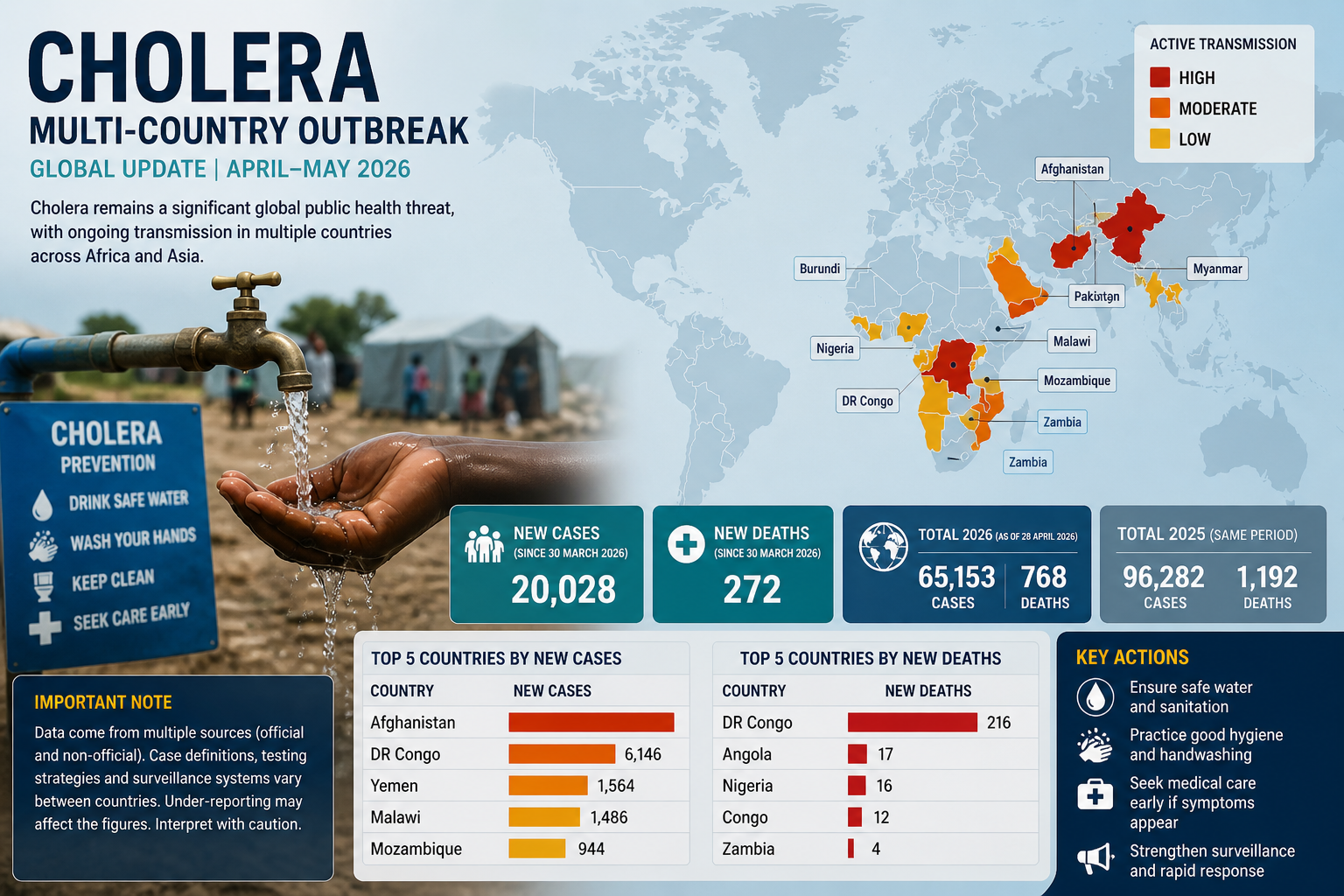
Cholera continues to pose a significant global public health challenge, with sustained transmission across multiple countries in Africa and Asia. According to the latest update from the ECDC Weekly Communicable Disease Threats Report (Week 18, 2026), between 30 March and 28 April 2026, a total of 20,028 new cases and 272 deaths have been reported worldwide. Transmission remains geographically widespread, affecting at least 13 countries, including Afghanistan, the Democratic Republic of the Congo (DRC), Yemen, Malawi and Mozambique.
It is important to note that the data presented originate from heterogeneous sources, including both official public health authorities and non-official reporting systems. Differences in case definitions, testing strategies and surveillance capacity across countries, as well as varying levels of underreporting, mean that global figures should be interpreted with caution.
At a global level, cholera activity in 2026 shows a lower cumulative burden compared to 2025, although this apparent improvement masks the persistence of high-intensity transmission hotspots, particularly in sub-Saharan Africa.
Global situation (2026 vs 2025)
| Period | Cases | Deaths |
|---|---|---|
| 2026 (Jan–28 Apr) | 65,153 | 768 |
| 2025 (same period) | 96,282 | 1,192 |
Despite a global decline, cholera transmission remains active and unevenly distributed
Most affected countries (latest reporting period)
| Country | New cases | New deaths |
|---|---|---|
| Afghanistan | 7,446 | 1 |
| DR Congo | 6,146 | 216 |
| Yemen | 1,564 | 2 |
| Malawi | 1,486 | 3 |
| Mozambique | 944 | 1 |
From a regional perspective, Africa continues to represent the main epicenter of transmission, with the Democratic Republic of the Congo accounting for the highest number of cases and deaths globally. The scale and persistence of the outbreak in DRC, combined with increasing activity in countries such as Mozambique, Malawi and Angola, highlight ongoing structural vulnerabilities, including limited access to safe water, sanitation and healthcare.
In Asia, Afghanistan remains a major contributor to the global caseload, while Yemen continues to report sustained transmission and mortality. Other countries, such as Pakistan and Myanmar, show lower activity compared to 2025, although endemic transmission persists. No recent updates have been reported from India. In the Americas, no new data have been reported since late March 2026.
Overall, the current epidemiological pattern reflects a complex global scenario, characterized by declining trends at aggregate level but persistent and, in some cases, expanding outbreaks in specific high-risk settings. These dynamics underscore the importance of maintaining robust surveillance systems, targeted interventions, and coordinated international response efforts, particularly in regions with fragile health infrastructures.
Risk interpretation
The current situation suggests a moderate global risk, with localized high-risk settings, especially in sub-Saharan Africa. For travelers, risk remains highly dependent on destination and exposure conditions, while for affected populations, cholera continues to represent a significant threat due to environmental and structural determinants.